DEED - COMMUNITY ENGAGEMENTS
What are all the possible “non-critical” situations where civilians need to get in touch with public safety (i.e., situations that do not warrant a 911 call)? What are the various touchpoints for public safety agencies to get in touch with the citizens in non-critical situations? What other touchpoints could we enable through design/technology to enhance community/public safety engagement outside of an emergency? In this project, we are trying to look at the relationship between first responders and community members and apply new technology to enhance relationships between them.
Although the topic area given by our client Motorola Solutions is about relationship between first responders and community members. After doing research, we reframed our opportunity area as how can we engage community members as well as different communities to address the original problems from a different perspective and design our solution accordingly.
Key words: design research, technology, interaction design, design strategy, design implementation, business innovation, prototyping, entrepreneurship
TOPIC SPACE
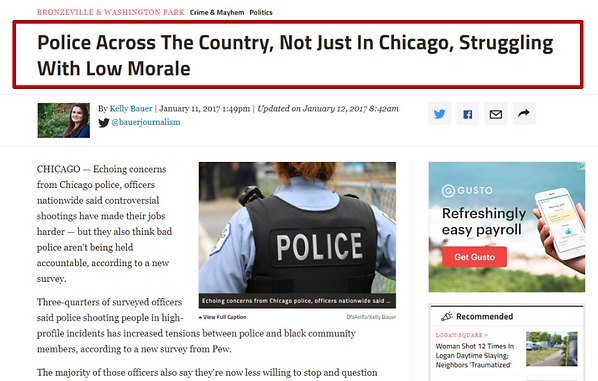
More than ever it is important that communities and public safety agencies engage with one another to increase trust, reduce inhibition in reaching out to the relevant agencies and ultimately make the community safer. There is a wide spectrum of situations that require public safety officials (e.g., fire, police) to respond. Critical situations require 911 calls, but there are several “non-critical” situations that require interacting with police and other public services outside of 911. The topic we are working on is focused on interactions of citizens and public safety agencies in these “non-critical” situations.
RESEARCH FINDINGS
BUILDING & UNDERSTANDING CONTEXT
We are trying to understand stakeholders in the system and how policing strategy evolved over time to have a better understanding of our topic space.


ADJACENT RELATIONSHIPS MAP
ERA MAP
REFRAME
We are focused on a solution that will boost civic engagement within and between communities in order to cultivate knowledgeable, connected, and motivated residents who are willing and able to help one another in times of need.
Our research shows that the trust gap exists not only between residents and first responders, but also from resident to resident, neighbor to neighbor. Because residents lack familiarity with one another (and thus lack trust), they aren’t collaborating to address ongoing neighborhood issues. Options that most residents see available to them for resolving issues are calling the police for assistance or doing nothing and hoping for the best/assuming it will blow over. This means that police are getting a lot of calls that aren’t critical, may not require police attention, or are for issues they aren’t equipped to address. We believe that a solution focused on supporting connections within and between communities will result in healthier, safer, smarter residents and an improved functional relationship with police.

REFRAME PRESENTATION WITH CLIENTS
INSIGHTS & DESIGN PRINCIPLES
After reframing our opportunity space we continue to do more focused secondary and primary research to come up with insights to generate design principles.

SECONDARY RESEARCH INSIGHTS SHEET

PRIMARY RESEARCH INSIGHTS SHEET

CLUSTERING INSIGHTS FROM RESEARCH

FINAL INSIGHTS CLUSTERS


NEW VALUE EXCHANGE
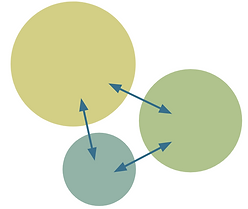
Communities are not solely spatial. They’re issue and attachment-based. Demographics shift, interests and concerns change. People rally around issues, and their attachment to those issues is what connects them to each other. Most are interested in more than one issue, so they end up belonging to many communities.
A solution that begins to build an invisible structure to help leverage these natural overlaps will make communities stronger, smarter, better informed, and safer. We see this solution supporting:
-
Awareness and appreciation of adjacent community issues
-
Added trust and familiarity between community members
-
Shared knowledge, resources an strategies
-
Positive effects of pooled efforts
In addition to the ways the solution will strengthen community, it also benefits a burdened police force in that communities will be able to articulate their needs better, will be ready to collaborate with police to address issues more effectively, and build safer communities without requiring additional police resources.

FROM:
TO:
SYNTHESIS
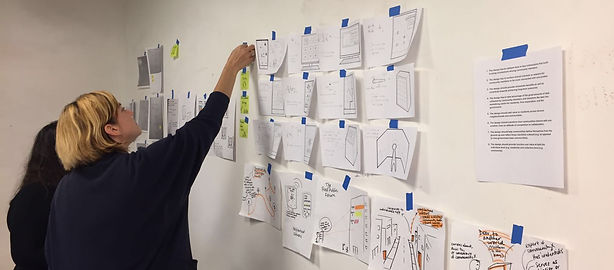
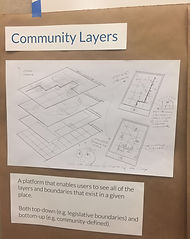
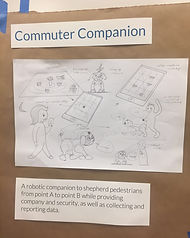
After reframing and generating design principles, we begin to ideate around them. We ideate around 30 ideas and then we vote for them and finally select 5 concepts to combine our other concepts around to further develop. Those 5 concepts including community layers, commuter companion, Divvy for safe community, free library of assets, and comm-you-nity. We present those concepts to our clients, and after receiving feedback, we combine good features from those concepts into our final solution.
CONCEPTS IDEATION AND EVALUATION
CONCEPT 1
CONCEPT 2

CONCEPT 3

CONCEPT 4

CONCEPT 5
PROTOTYPING
Unlike the options available to us now, we decide to focus on a solution that builds a culture of participation through activities that bridge people within and between communities.
VALUE PROPOSITION
USER INTERFACE
There are five phases in the user journey on Deed, between getting started on the platform and actually becoming a deed creator, including review, commit, do, reflect and create.




WIREFRAME AND WORKFLOW (PREVIOUS VERSION)
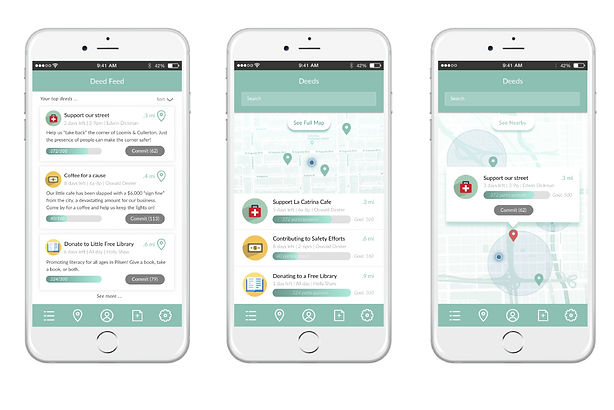
The Deed Feed shows a list of relevant ongoing deeds based on:
-
user location
-
frequently visited places
-
user interests
-
participation history
Map view allows users to easily see location of nearby deeds as well as deeds in frequently visited areas.
REVIEW
COMMIT
Deed-tails page provides more information and updates.
Deed participants list reveals who has shown up for the deed.
And a map view reveals where participants have come from.
REFLECT
Deed-tails page reflects goal achievement.
User profile reveals participation stats and accomplishment badges.
Karma footprint summarizes the impact of the doer.
CREATE
In order to create a new Deed, users are guided through a series of prompts.
ROADMAP
In the future, new features will be built into the platform:
-
API Integration
-
Virtual currency as participation proxy
-
Crowdfunding Deed
