
C-CHICAGO
This concept is a revised plan of Chicago public transportation system that new travelers in the city are able to explore local neighborhoods easily and efficiently by navigation signages, a gadget and an app, and face-to-face support by local business owners. The hub to connect multi systems is a device “Hoods Guide” which takes a tourist to unique local excursion in response to his/her preference, pay and check in to all transport without tickets, and connect to local experts to extend his/her exclusive journey. This system enables Chicago local government to invite overseas travelers, revitalize local economy, and increase the tax revenue.
Key words: service design, system design, UX/UI design, interaction design, information architecture, scenarios, business design
INSIGHTS & DESIGN PRINCIPLES FROM RESEARCH
We interviewed six interviewees about their experiences of traveling in Chicago. We analyzed our transcripts and generated insights. Then we clustered out insights and created four design principles for ideation.

RESEARCH DEBRIF

FROM OBSERVATION TO INSIGHTS

DESIGN PRINCIPLES


CONCEPTS
GENERATION
We brainstormed concepts according to our design principles and evaluated them by business value and user value. Then we refined some concepts to increase their values. We combined our combined into several solutions and then intergrated them together into a service blueprint.
BRIANSTORMING
CONCEPTS EVALUATION
USER SCENARIOS
We created a persona and built a scenario to present the experiences from a user's perspective.
(Detailed stories refer to the academic paper)

John finds a kiosk
John gets a digital guide
John synchronizes his setting
John begins his scavenger game
John gets on a beer train
John finds special trains
John learns the culture on the go
John finds interesting spots
John gets his souvenirs
SYSTEM & TOUCHPOINTS DESIGN


To support our service, we designed not only the front end but also the backend of the system. After designing the overall service, we identified touchpoints with end users where we will introduce our kiosks and devices. We used information architecture to clarify the function and information structure of the kiosks and devices to make sure users can get what they need from our service with the least frictions.
KIOSK AND DEVICE DESIGN

INFORMATION ARCHITECTURE
BUSINESS DESIGN
C-CHICAGO serves as a platform which connect travelers, local business and residents, and public transportation system and benefits all the stakeholders. We also think about how our service system will grow in the future.
(Detailed information refers to the academic paper)

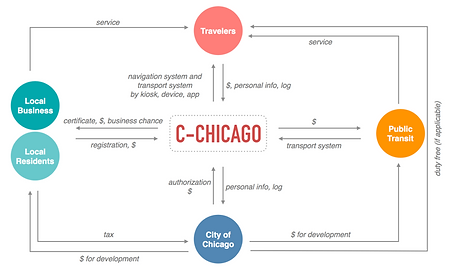
VALUE WEB
ROADMAP

HSI Approach
Human-System Integration (HSI) goes a step beyond traditional fields like Human Factors and is concerned with ensuring that the needs of people are considered throughout the system development process; especially with regard to people’s adoption of technologies, learning functions of new systems, and their overall participation in systems’ operation. Hence we can say that HSI is primarily focused on providing insight to the System Design and development. HSI is also known as Macroergonomics and/or Socio-Technical System Design that brings to forth all the stakeholders of a system and focuses their energy on solving complex problems innovatively.