
In this project we are partnering with Art Institute of Chicago (AIC) and Chicago Public Library (CPL) to think about how can we use art programing to engage young adults.
From CPL's perspective, they are trying to attract more young adults because young adults only constitute a small part of the patrons population. Also we work with CPL's West Town Branch, so our program should be customized to the needs of the community. From AIC's perspective, they are trying to engage more with residents from communities who usually don't have access to AIC. So young adults are whom we are targeting on.
To make the project successful, we need to leverage both AIC and CPL's assets. Also we need to make sure the program we design can be implemented easily. To engage young adults, we need to learn what they want and what they care. Because in this project, people we are targeting on are non-users of the existing service, so we need to research on lots of analogous events and programs to find why they are interested in going to certain things. After designing the program, we prototype to test our solutions.
Key words: design research, interview, observation, secondary research, service design, prototyping, non-profit
ART PROGRAM IN LIBRARY
DESIGN RESEARCH & OPPORTUNITIES
DATA COLLECTION
To better understand out clients and users we are trying to engage through programming, we conducted secondary research to learn strategic goals of CPL and AIC, assets they have which we can leverage, successful programming experiences of other institutes, demographical information of West Town, and existing studies about young adults behaviors and community engagement. We conducted primary research through interviewing stakeholders from both CPL and AIC, observing CPL and other institutes , participating events related to art, and intercepting young adults to learn more about what young adults do, what they want, how to engage them through art programming.

SECONDARY RESEARCH

PRIMARY RESEARCH
UNDERSTAND THE SYSTEM
We are trying to understand what are other stakeholders who are involved in this service system. We use ecology map and value web to understand how values are exchange in the system and potentials to engage more with stakeholders who are not directly involved now.

VALUE EXCHANGE WEB

BUILDING ECOLOGY MAP

ECOLOGY MAP
DEFINE OPPORTUNITY AREAS
After analyzing our research data, we generated three hypotheses about how to engage young adults through art programming. After conducting more researched, we develop those three hypotheses into four opportunity areas which will guide our concept generation and evaluation.

OPPORTUNITY AREA 1

OPPORTUNITY AREA 3

OPPORTUNITY AREA 2

OPPORTUNITY AREA 4
IDEATION & CONCEPTS REFINEMENT
IDEATION
According to the insights and opportunity areas we generated, we ideate concepts and cluster them into bigger concepts. Then we selected 12 concept clusters and refine them.
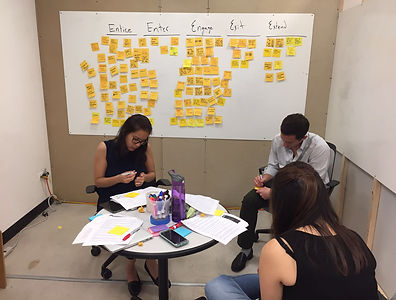
IDEATION SESSION

CONCEPTS CLUSTERING
COLLECT FEEDBACKS
After sketching concepts, we presented our initial concepts to our clients from CPL and AIC. We asked feedback about desirability, feasibility and viability to move forward.
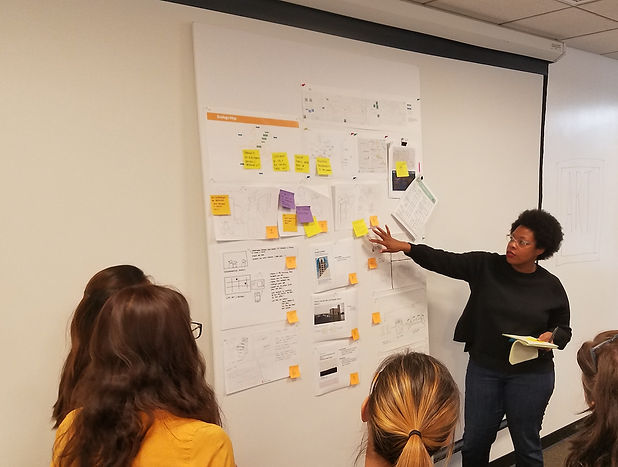
SHARE-OUT SESSION WITH CLIENTS

BOARD WITH CRITIQUE ON IT
SELECT DIRECTIONS
After collecting feedbacks from our clients, we refined our concepts and combined good features from 12 concepts into two directions.

DIRECTION 1

DIRECTION 2


PROTOTYPING & EXPERIMENTS

PREPARATION
To test our hypotheses, we make prototypes to test with real users. We select art pieces we are going to use and measure the size of the space we are going to prototype then we design several iteration of our prototype and test them in the library with patrons.

SELECT ART WORK
MEASURE SPACE
TEST PROTOTYPE
We iterate certain rounds of prototype to engage young adults with storytelling. We set up the stand in the library and observe how people interact with it. Then we intercept them to collect feedback about our service and analyze the data we collect to improve our design.

FIRST ROUND ITERATION

SECOND ROUND ITERATION


TOUCHPOINTS DESIGN
THIRD ROUND ITERATION

INTERCEPTION

INTERCEPTION

BOOKMARK FOR ONLINE CHANNEL
CONCEPT PIVOT
After testing our initial concept, we found it's very hard to attract young adults to interact with our booth, no matter it's digital or physical. We analyzed why the concept didn't work and conducted a second round of ideation. We then pivoted our concepts into one which is easier for young adults to participate and we also tested our prototype in multiple locations out of library. The test result is inspiring, and more than 40 people interacted with our prototype in three very different locations.


CONCEPT PIVOT
NEW PROTOTYPE
NEW PROTOTYPE DEMO

TESTING @ IIT DTC LIBRARY

TESTING @ IGNITE CHICAGO
